
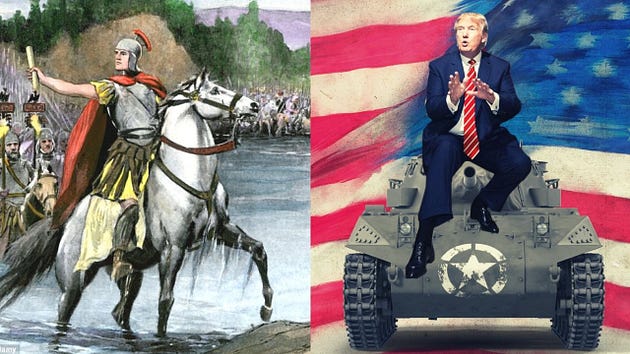
When Julius Caesar crossed the Rubicon River en route to the Roman Senate with his 13th Legion in 49 BCE, he established not only an historical marker designed to showcase the absolute power of his military might and authority, but he also provided a living example that both elucidates history yet portends modern times in so many ways.
I hadn’t thought about that iconic historical moment since studying history in high school and college; however, this past summer, as protests swelled throughout the United States following the outrage surrounding the death of George Floyd, President Trump did something on June 1st no prior president has ever come close to doing. As protestors gathered outside of a barricade lining the exterior grounds of the White House, Trump ordered federal law enforcement agents from the Department of Homeland Security (DHS) to use tear gas, rubber bullets, and other riot control tactics against U.S. citizens. He allegedly did so in order to safely leave the boundaries of the White House and clear a path for him to walk across the street of Lafayette Square to St. John’s Episcopal Church. There, he took what has been described as a “photo-op” as he held up a Bible — one he implied was not his own — before retreating into an underground safety bunker beneath the White House.
While Joint Chiefs of Staff Chairman General Mark Milley accompanied the President on that march to St. John’s, he later regretted the decision, saying in a video commencement address to the National Defense University: “My presence in that moment and in that environment created a perception of the military involved in domestic politics.”
Indeed, over the following weeks, America would witness — firsthand — increasing levels of authoritarian behavior as President Trump attempted to implicate military involvement in domestic politics as he sought to quash protest demonstrations throughout the country. From New York to Minneapolis, Seattle, Portland and Los Angeles, Trump directed DHS Law Enforcement Agents to use excessive force against peaceful protest demonstrations in the form of tear gas, rubber bullets, and forced detainment under the Protecting American Communities Task Force (PACT), while simultaneously decrying protestors — American citizens themselves — as violent looters and terrorists without distinguishing between peaceful protestors exercising their First Amendment rights and those whose agenda was criminal arson and burglary. Along the same lines, President Trump threatened to send military forces in the form of the National Guard to quell protests in those cities, specifically in Portland, OR, against the advice and petitions of local governmental officials.
This wave of protests was not the first time Trump had used (or threatened to use) federal and/or military troops under his authority as Commander in Chief. In the final months of 2018 — hardly halfway through his presidential term — Trump asked state leaders for voluntary contributions of National Guard troops to be sent to the Mexican border to assist Border Control under Operation Guardian Support. While this itself was not necessarily a breach of ethics or authority, what drew criticism from American military leaders was Trump using his Presidential power to lean on then-Defense Secretary Jim Mattis to authorize sending 800 active-duty troops to the U.S.-Mexico border. However, according to the narrative published in an article on the matter from Military Times, those 800 active-duty troops would only “be providing administrative duties, not law enforcement.”
For scholars and analysts who have studied authoritarian leaders in the past, these events resonate. At the end of the day, the use of government troops by a nation’s leader on its own citizens, rather than on a foreign threat, represents a page straight out of a dictator’s handbook. And the advantage of history in this regard over reading current headlines is that it does show how the movie ultimately ends.
In the year 509 BCE, the Etruscans, who had conquered Rome, were later overthrown by Roman citizens — citizens who then established their Roman “polis” as a “Republic,” a form of government in which citizens elect officials to represent them — in this case through a “Senate.” After establishing itself as a Republic, Rome, which won its liberation through military conquest, and knew the pros and cons of military power up front and personal, declared it law that no military commander could bring military forces across the Rubicon River and into Roman territory. This territory, on Rome’s northern border and on the southern frontier of Gaul, was one over which Roman military leader Julius Caesar had been appointed as Governor after his brilliant campaign to conquer it, a feat he personally memorialized in his tome, the Gallic Wars.When Caesar’s term of governorship came to an end in January of 49 BCE, he was ordered by the Roman Senate to disband his legions of troops and return to Rome — alone.
“Sensing the political winds,” Caesar defied the Senate’s orders and instead marched his 13th Legion across the Rubicon and into Rome. Despite cries of treason and insurrection from the Senate, Caesar pressed on and despite the noise, chaos and cacophony around him, particularly after a series of political machinations, he declared himself “Emperor for Life”, turning the Republic into a dictatorship, initiating an internal civil war, at a huge cost to Rome, but a benefit to himself — the Emperor — who had become the most powerful individual on the planet.
Five years later, on the Ides of March 44 BCE, Julius Caesar was assassinated, as Marcus Junius Brutus (a.k.a. “Brutus”,) repeatedly plunging his knife into Caesar’s torso, anecdotally declares, “Sic semper Tyrannis (Thus always to tyrants.”)
“Thus, always to tyrants,” indeed. Caesar was far from the last politician in history to “cross the Rubicon.” And they always inevitably tend to share the same fate!
Vlad III of the 15th-century Wallachian empire, Napoleon Bonaparte of the 18th century French empire, and Kaiser Wilhelm II of the Austro-Hungarian empire were three more historical figures who followed Caesar’s example of dictatorship by utilizing military force against their own citizens. More modern dictators such as Vladimir Putin and Kim Jong-Un exhibit similar authoritarian behaviors that President Trump himself has praised.
In our Republic — the United States of America — those who are elected to the Office of President assume the role of Commander in Chief. This is done to allow the President’s mobilization, deployment, and use of the country’s military in times of war against foreign threats. While uniformed military did accompany the President to St. John’s Episcopal on June 1st, National Guard troops did go to the Mexican Border under Operation Guardian Support in the final months of 2018, and Federal Police did militarize in Portland under the PACT this past July, it was not without severe pushback from high-ranking military officials, largely due to the ethical ramifications of sending federal agents to deal with domestic policy issues, a concern expressed by military and policy experts alike, but not by the President himself.
It is not as if these are novel issues for us to address in modern times. Indeed, the irony in these situations lies within the very time-worn proscriptions embedded in the U.S. Constitution, one of our nation’s founding documents drafted and subsequently voted into law by our nation’s founders — themselves victims of a tyrannical monarch they sought to escape.
Within the Constitution, the political founders of the United States made clear the importance of Separation of Powers within their new Republic, which not only divides our federal government into three primary branches — Executive, Legislative and Judicial — but also separates the governing authority into Federal and state governments.
This separation is what allows law enforcement and police officers to uphold both State and Federal law within localized communities and allows the President of the United States to assume the role of Commander in Chief and militarize troops in the face of foreign threats. The former of these was a positive addition to our nation’s Constitution, one of many drafted by several members of the United States’ Founding Fathers — Alexander Hamilton, James Madison and John Jay — to gain sufficient political traction to ratify the Constitution through public vote, largely through publication of the Federalist Papers: a collection of 85 essays anonymously written by the aforementioned three founders and circulated to early citizens of the American Republic in order to express the importance of and limitations on the power exhibited by the new nation’s body of government.
In the Federalist papers, John Jay wrote on the importance of protecting not only America’s citizens, but its government from the dangers of foreign political influence. James Madison wrote predominantly on the importance of separation of governmental powers and the limitations of those powers — both state and federal, as well as the branches of federal government — while Hamilton wrote on the Judicial branch, the process of elections, term limitations, and the importance of preserving the nation’s union from threats; foreign and domestic.
All of this was not circumstantial; it was because the first federal political cohorts of the new Republic of the United States knew firsthand of the dangers that a single, authoritarian leader can bring to a country and its people.
At the end of the day, it’s clear that were Donald Trump not limited by the authority of the Constitution and the culture of our American Republic, he would continue to gravitate closer and more intensely to occupying Washington D.C. and other cities with military forces to push back against the protests of citizens — a right those citizens are granted under the very same Constitution that grants President Trump the role of Commander-in-Chief.
And while it is true that sometimes, in the streets of our cities — particularly in the face of racial divides — it is not always obvious how to permit citizens the right of peaceful protest, while securing the streets against looters, criminals, and anarchists — what is clear is that, under our Constitution, use of federal military forces against one’s own citizens is a bridge too far. In short, when any President co-opts the authority to send the military down the streets of Lafayette Square to part crowds for a presidential photo-op, or into Portland and other cities to quell gatherings or other assemblages which the President defines as a “riot,” what then stops him from sending the military into every major city in the nation to secure voting centers across the entire country from what Trump decries as the greatest voting fraud in the history of the country?
This should hardly be viewed as far-fetched, since Trump has continued to express his fascination with authoritarian power, regimes and leaders time and time again, and entices his campaign crowds to chant for 12 more years, when he is constitutionally only permitted four more, assuming he would even win this election, of course. What may not be clear yet to some of us, but is very clear to me is that, were Trump to have his way, the United States would join the likes of those same leaders and regimes as Trump establishes his place in history on this side of the Rubicon.
Democracy is inherently an inefficient form of government. It is as messy as it is divisive, particularly within the cardinal theme of “separation of powers” imbedded in our governing documents and in our political culture, but, it is also without a doubt the very best form of government, because, as history has shown us all too often, and modern times continues to reinforce: “power corrupts and absolute power corrupts absolutely.”