
When Ivanka Trump registered as a Republican for the first time in 2018, her husband Jared Kushner, also switching parties, commented: “I think the Republican Party is growing now that people like me feel comfortable being part of it.” As a lifelong Democrat, it wasn’t clear who “people like me” were?
Jared and Ivanka are worth close to $800 million, looking more like Republicans than Democrats, and although social media director Dan Scavino recently claimed the President is “truly a man of the people,” he has certainly not been a traditional Republican.
From the moment he launched his presidential campaign on June 16th, 2015, Trump had a message that was tailor-made for the white, working class, evangelical voters his campaign knew could carry him to the White House. He promised to be tough on illegal immigration, bring jobs back to the United States, and call out the government for not telling the truth about the economic despair we are in.
Trump’s win emboldened a shift already prevalent across the country — one which Professor Katherine J. Cramer referred to as the rise of “rural consciousness” in her book, The Politics of Resentment. Trump spoke directly to that rural sentiment, focused on America First: favoring American manufacturing jobs over cheap imports, demonising China, and shutting down our borders — policies out of step with Republican orthodoxy, but embraced by rural communities.
Thereafter, Trump rallied the Republican Party around his own narrative, initially rejected by an A-List of Republicans, but who were since brought in tow behind the man who impassioned supporters and rejuvenated the Party. Joe Gruters, Chairman of the Florida GOP, said, “…Donald Trump is going to have a lasting impact on the party. He obviously has the pulse of the people, and the party coalesced around him. It’s as simple as that.”
In short, while Trump may be ideologically and intellectually distant from the conservative DNA spawned by William F. Buckley as founder of the National Review in 1955, his erratic, often impulsive decision-making, has branded a new Party — the Trump Party — not the Republican Party for which he ran, or the Democratic Party with which he was once registered, in his own image and likeness.
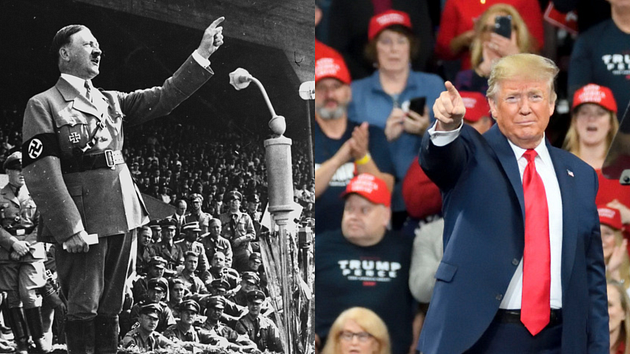
Interestingly, we have witnessed this kind of emotive, populist leadership before. The Atlantic described the man: “He is impatient of cool, intellectual considerations. He has a poor grasp of abstract principles and puts his faith in high feeling and strong emotion. Not seeing that civilization is a structure slowly built up by orderly procedure and respect for law, he is all for immediate action. He wants to apply his ideas at once by violation of law, if need be. The right of private judgment (that is, his right) is to be unlimited, beyond law.”
The article was entitled, “Hitler and Hitlerism: A Man of Destiny”, a piece written by journalist Nicolas Fairweather and published by The Atlantic in its March 1932 issue.
A rousing speaker, Hitler quickly rose to the head of the National Socialist German Workers’ Party, expanding its membership by inspiring in the masses a sense of nationalist pride. Portending current “lock ’em up” rhetoric, his portrayal of reigning politicians as “criminals,” combined with high unemployment, helped swell his party’s numbers.
In 1933, with just 33 percent of the vote and no clear majority, Hitler took power. Within the space of two months, he blamed the Reichstag fire on Communists and used it as justification to invoke Article 48 of the German Constitution, abolishing freedom of speech, assembly and the press, detaining his political opponents, and paving the way to dominate what started as the National Socialist German Workers’ Party to what became Hitler’s Nazi Party, as a dictator, to rule over what had been, until then, a democratic parliament.
The German people did not opt for dictatorship; but they got it, by doing nothing to stop it.
Trump may not be a Hitler — and that is not the thesis here — however, the President has shown a shocking admiration for dictators: Russia’s Vladimir Putin, the Philippines’ President Rodrigo Duterte, and Turkish President Recep Tayyip Erdogan. After meeting North Korea’s Kim Jong Un in 2018, for example, he said, “He speaks and his people sit up at attention. I want my people to do the same.”
He has sought to unify his base by following every dictator’s playbook as he blames scapegoats — Hillary Clinton, immigrants, China, the Democrats, the Fake Media, lying politicians, and now even Dr. Anthony Fauci — for whatever ails the country. In 1925, Hitler wrote in Mein Kampf : “The art of leadership… consists in consolidating the attention of the people against a single adversary and taking care that nothing will split up that attention,” a lesson Trump not only learned too well, but has made his own personal art form.
Trump’s 2020 “Law and Order” campaign is no different, blaming Biden and the Democratic Radical Socialist Left for protests against racial injustice which occurred during his own administration, threatening to send federal forces into states to quell them. Larry Sabato, director of the Center for Politics at the University of Virginia, warned these tactics were, “an unmistakable hint of what a second Trump term will be like. There’ll be no hesitation to do any of this.”
As a constitutional menace, Trump has come closer than any American president in history in his quest to erode democracy as he has openly chided his supporters to chant for “twelve more years.” President Trump won’t get 12 more years, of course. Even if he wins, he will only get four more, thanks to the 22nd Amendment to our Constitution, which was, alas, not available to the Weimar Republic which Hitler dissolved.
But the pivotal question is whether the nation can even survive four more years of the Trump Party? Policies can be advanced and debated in a democratic republic. And Trump’s may be better or worse than others, based on one’s views. But Dan Scavino’s boast is our clear warning sign: “President Trump is the first leader who has been too strong, too tough and too savvy to be crushed by the status quo establishment and the political media class.” Says Scavino: “You know, the President cannot be beaten.”
And that is the real issue, isn’t it? It’s not policies; it’s our Constitution. It is in jeopardy in this election. For that, Election 2020 is not a race between the Republican Party and the Democratic Party; it is an electoral race between the Republican Party and the Democratic Party, on the same side, running against the Trump Party, on the other side: two political parties knowing what they stand for and bracing against the barbarian force inside the gates of the White House.
The ultimate question is whether we, as Republican and Democratic voters, are going to win or look back four years from now and ask ourselves why, when faced — like the Germans — with a clear choice, we saw what was happening and did nothing to stop it.